

Precision Metal Manufacturing
We manufacture metal parts using laser cutting and stamping for validation, homologation, and commercial presentations. From 1 part up to 500 units.
Request a quote.
The Technical Process: From Sheet Metal to Functional Component
When you have a sheet metal design on your screen, the path to turning it into a real part involves two complementary processes that we master at ProtoSpain: laser cutting and stamping. Here we explain how each process works and when it is best to use one or the other.
Laser Sheet Metal Cutting: Contact-Free Precision
Laser cutting uses a high-power, focused beam of light to melt, vaporize, or burn through metal along a CNC-controlled path. Imagine a pencil of fire capable of drawing any shape on a sheet of steel, aluminum, or stainless steel with a precision of 0.1 mm.
The process works as follows: the laser locally heats the material while a gas jet (nitrogen for clean finishes, oxygen for higher cutting speed in steel) expels the molten metal. The result is clean edges, virtually burr-free, ready for the next operation.
Types of lasers we use:
Fiber laser technology dominates our facilities for several reasons: it cuts faster (up to 25 m/min on thin sheet metal), consumes less energy, and offers a service life exceeding 100,000 hours. It is particularly efficient with reflective metals such as aluminum, copper, and brass, where other laser technologies struggle.
Stamping: High-Productivity Forming
Cold stamping transforms sheet metal through controlled pressure. A die stamps its shape onto the metal, cutting contours, punching holes, or forming features in a single operation.
The difference compared to laser cutting? Stamping truly stands out when you need to repeat the same part dozens or hundreds of times. The unit cost drops significantly because, once the die is manufactured, parts are produced in seconds.
At ProtoSpain, we manufacture prototype dies in 7075 aluminum or P20 steel capable of withstanding between 500 and 5,000 strokes. These are not production dies (which cost ten times more and take months to deliver), but optimized tools designed to validate your design with real parts before committing to final production tooling.
Materials We Work With
Carbon steels (S235, S275):
The workhorse of the industry. Weldable, cost-effective, and available in multiple thicknesses. We use them for structures, brackets, and components where strength is more critical than aesthetics.
Stainless steel (304, 316L):
Guaranteed corrosion resistance. Ideal for food, medical, and aggressive environments. Grade 316L adds enhanced resistance to chlorides, making it perfect for equipment exposed to saltwater or chemicals.
Aluminum (5754, 6082):
Lightweight with an excellent strength-to-weight ratio. Widely used in the transportation and electronics industries for enclosures, heat sinks, and structures where every gram matters.
Copper and brass:
Excellent thermal and electrical conductivity. We use them for connectors, heat sinks, and components where these properties are critical. Fiber laser cutting handles them reliably up to 5–6 mm thickness.
CNC Bending: The Perfect Complement
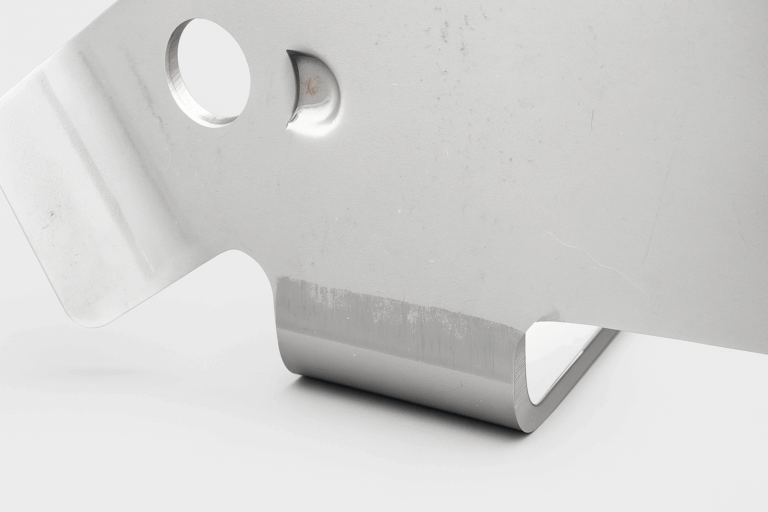
A cut sheet metal part rarely remains flat. Our CNC press brakes, with capacities of up to 3 meters and 320 tons of force, transform flat patterns into three-dimensional geometries.
An angular accuracy of ±0.5° allows parts to fit correctly on the first attempt. We know how to compensate for springback in each material and thickness—something that can only be learned through experience and testing.
Manufacturing of Devices for Small Series
This is where we truly add value. We are not talking about mass production, but about quantities that do not justify major tooling investments yet require fast delivery and impeccable quality.
Parts for Technical Validation
Before committing resources to series production, you need to verify that your design works. We manufacture the first units in final materials so that you can:
- Verify assemblies: Do all parts fit? Are the holes aligned? Are the tolerances correct?
- Perform mechanical testing: Strength, fatigue, and vibration tests using real parts, not simulations
- Iterate quickly: If something doesn’t work, we modify the file and cut another version in hours, not weeks
Laser cutting is ideal for this phase because each iteration costs the same. You don’t pay additional tooling costs for moving a hole to a different position.
Components for Homologation
Certification processes require parts manufactured exactly to drawing specifications, with traceable materials and complete documentation.
We deliver:
- Material certificates in accordance with European standards
- Dimensional inspection reports for critical characteristics
- Dimensional inspection reports for critical characteristics
In the medical sector, this phase is critical before proceeding to FDA approval or CE marking. In automotive applications, crash tests and durability testing require components that are truly representative of the final product.
Prototypes for Exhibitions and Trade Shows
A trade show such as Advanced Manufacturing Madrid or Formnext can be the opportunity to present your product to thousands of qualified visitors. But you can’t show up with just a render on an iPad. You need something tangible—something to touch, to demonstrate, that actually works.
We manufacture:
- Parts with the finish and aesthetics of the final product, even if internal mechanisms are simplified. What matters is conveying professionalism and quality.
- Designed for travel. Tool-free assembly components, weight optimized for air transport, and custom carrying cases.
- 50, 100, or 200 units of your product’s flagship component, so visitors can take home a tangible keepsake that ends up on their work desk.


Technical Capabilities That Make the Difference
Parameter | Laser Cutting | Stamping |
|---|---|---|
Thicknesses | 0.5 – 12 mm steel; 0.5 – 10 mm stainless steel; 0.5 – 8 mm aluminum | 0.5 – 3 mm (prototype dies) |
Maximum dimensions | 3.000 × 1.500 mm | Depending on the die (up to 600 × 400 mm) |
Tolerance | ± 0,1 mm | ± 0,2 mm |
Optimal volume | 1 – 100 parts | 50 – 500 parts |
Lead time | 3 – 6 days | 1 – 2 weeks (tooling included) |
Automotive
Brackets, engine mounts, battery trays for electric vehicles, and conceptual body components. We manufacture the prototypes that engineers later validate on test benches before approving production dies.
The industry increasingly demands lighter materials and software-optimized geometries. Laser cutting makes it possible to produce organic shapes that were previously unthinkable in sheet metal.
Electronics and Telecommunications
EMI/RFI enclosures, heat sinks, and rack equipment chassis. Laser precision allows the creation of display windows, connector cutouts, and mounting tabs in a single operation.
For short production runs of specialized equipment (radio stations, measurement equipment, control systems), investing in dies makes no sense. We cut and bend exactly the number of units you need.
Industrial Machinery
Control panels, protective guards, hoppers, and structural supports. Parts that may not be visible but are essential to keeping machines running.
Many special-purpose machinery manufacturers work on a made-to-order basis. Each machine is slightly different. Laser cutting adapts to this variability without cost penalties.
Medical Devices
Operating room equipment, components for diagnostic devices, and structural elements for hospital furniture. We routinely work with 316L stainless steel and surface finishes designed to facilitate cleaning and disinfection.
Traceability is essential. Each batch is supplied with its corresponding material and process documentation to support audits and certifications.
Aerospace and Defense
Structural brackets, protective shielding, and components for auxiliary systems. Material and documentation requirements are stringent, and production volumes are typically low.
We have collaborated on mock-up projects for presentations to end customers, where the appearance had to be indistinguishable from the final product.
Finishing Processes That Complete the Product
The cut and bent part is only the beginning. We offer a full range of finishing treatments so you receive components ready for use:
- Peinture en poudre : couleurs RAL, finitions mate, satinée ou brillante. Excellente résistance et uniformité.
- Aluminum anodizing: Corrosion protection and optional colors (black, gold, blue) without compromising thermal conductivity.
- Blasting: Evens the surface, removes machining marks, and prepares it for painting.
- Brushing: Directional satin finish that conceals wear scratches. Highly demanded for equipment front panels.
- Laser marking: Logos, traceability codes, serial numbers. Permanent, does not add thickness, withstands extreme conditions.
- Submit your design to us
DXF or DWG files for 2D parts, STEP or IGES for 3D. If you only have a sketch, we can work with that too.
- Analysis and Quotation
Within 24 hours, you will receive a quote including material options, finishes, and lead times. We will also highlight any manufacturability issues we detect.
- Manufacturing
We optimize nesting (arrangement of parts on the sheet) to maximize material usage. We cut, bend, and apply finishes.
- Quality Control and Delivery
Dimensional verification of critical features. Protective packaging. Transportation included to any location in Europe.
How many parts justify making a die?
From 50 identical units, a prototype die starts to be cost-effective compared to pure laser cutting. Below that quantity, laser cutting is more economical since there is no tooling cost.
Can I combine laser cutting with complex bending?
Of course. Our CNC press brake supports sequences of multiple bends. Whatever the laser cuts, we bend to create U-, L-, Z-shaped parts or complete boxes.
What accuracy can I expect in bent parts?
±0.5° in angles and ±0.3 mm in linear dimensions after bending. For tighter tolerances, we machine critical features.
¿Puedo recibir las piezas pintadas o tratadas?
Of course. We handle everything in-house: RAL powder coating, anodizing, chrome plating, and blasting. You receive the part ready for assembly.
Whether you need 5 parts for internal validation or 200 to outfit your booth at the next industry fair, we manufacture with the same attention to detail.
Laser cutting and stamping are mature technologies, but the difference lies in who applies them. Two decades working with engineers and designers have taught us that lead times matter as much as tolerances, and that a well-executed part is worth more than ten excuses.
Do you have a sheet metal project in hand? Send us your drawing or sketch, and within 24 hours you’ll receive a detailed proposal with options and realistic lead times. No commitment, no fine print.
ProtoSpain: Metal prototypes that work, delivered on the timelines you need.