Reaction Injection (RIM): Prototypes and Large-Format Short Runs
1. Introduction: What RIM Is and What It’s Used ForReaction Injection Molding, internationally known as RIM (Reaction Injection Molding), represents an advanced technical solution when your project requires large parts, complex geometries, and limited runs without assuming the prohibitive costs of conventional production tooling.
At ProtoSpain, we master this process to manufacture everything from unique functional prototypes to validation series of up to 200 units, offering high-quality polyurethane components that combine mechanical strength, lightness, and excellent surface finishes.
RIM is especially valuable in critical phases of product development: technical validations, regulatory approvals, commercial presentations at trade shows and events, and bridge production while the definitive series molds are being manufactured.
2. Technical Section: How the RIM Process Works
2.1. 2.1. Process Fundamentals
Unlike traditional thermoplastic injection, which requires high pressures and extreme temperatures, RIM operates under radically different principles, making it ideal for prototyping and short runs.
The process in essence:
RIM uses two low-viscosity liquid components —typically a polyol and an isocyanate— which are precisely metered and intensively mixed in a special head immediately before injection. This reactive mixture is injected at low pressure (0.5–5 bar) into the closed mold, where an exothermic chemical reaction polymerizes the material, forming solid polyurethane with the desired mechanical properties.
Technical advantages of low pressure:
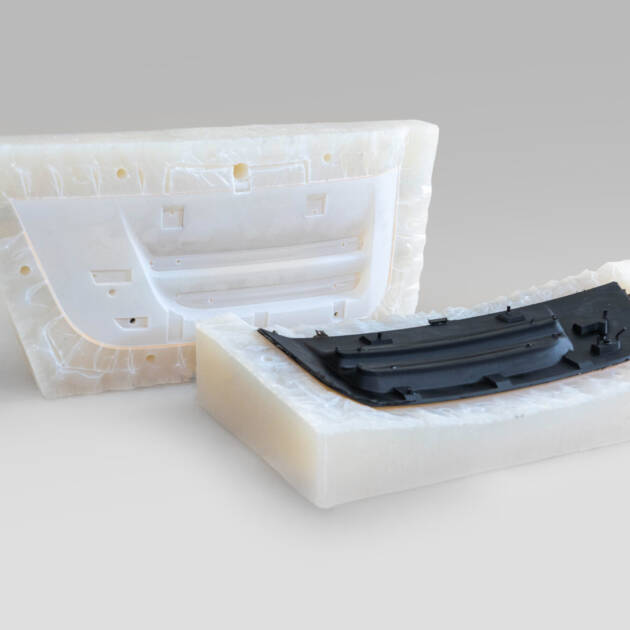
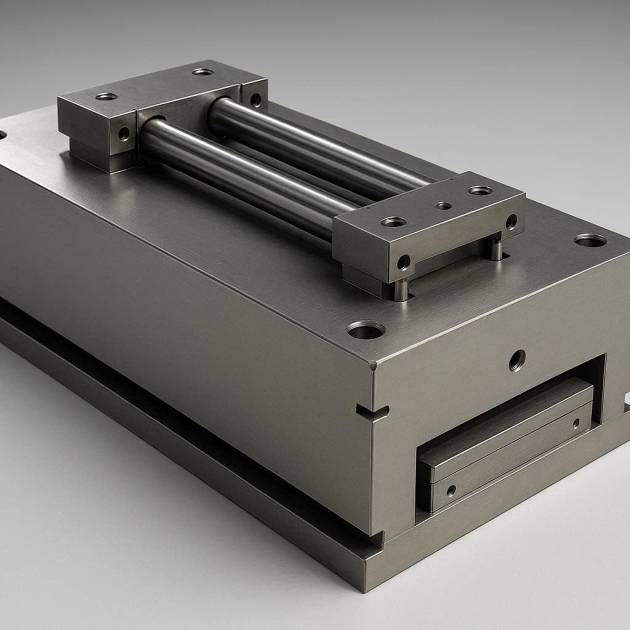
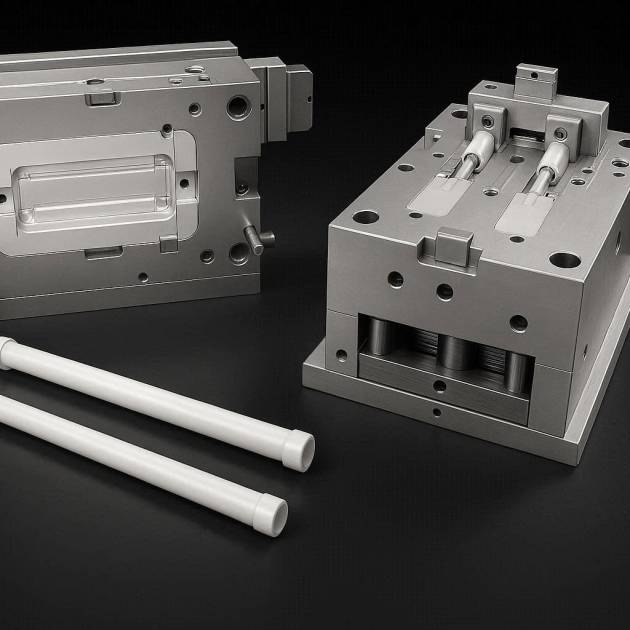
Working at pressures 10–20 times lower than conventional injection allows molds to be made from more economical and fast-to-machine materials: aluminum, reinforced epoxy resins, or even hybrid molds. This dramatically reduces both cost and tooling lead time, allowing production to start 3–4 weeks after design approval.
2.2. 2.2. Available Materials and Formulations
At ProtoSpain, we work with a wide library of polyurethane formulations covering a full spectrum of properties:
Rigid polyurethanes (Shore D 60–85)
Densities: 600–1,200 kg/m³
High impact resistance similar to ABS or PC
Stiffness modules comparable to structural thermoplastics
Thermal resistance up to 120°C in continuous service
Applications: structural housings, equipment panels, machinery components
Semi-rigid and flexible polyurethanes (Shore A 60–90)
Excellent impact absorption
Elastic memory for dynamic applications
Superior abrasion resistance
Applications: bumpers, shock absorbers, ergonomic components
Structural foam polyurethanes
Rigid outer skin with cellular core
Weight reduction 30–50% without sacrificing stiffness
Excellent thermal and acoustic insulation
Applications: large panels, transportation components
Special formulations:
High-temperature resistance (up to 150°C)
Glass-fiber reinforced for higher stiffness (RRIM - Reinforced RIM)
Flame retardants for safety-compliant applications
Biocompatible for non-implantable medical devices
2.3. 2.3. Dimensional Capabilities and Tolerances
Part dimensions:
Maximum size: up to 2,000 × 1,000 × 500 mm
Part weight: from 100 grams up to 20 kg
Wall thickness: optimal 3–10 mm (possible 2–25 mm)
Dimensional tolerances:
Typical tolerance: ±0.5 mm for large parts
Tight tolerance: ±0.3 mm in critical areas with shrinkage control
Final tolerances depend on mold design and material formulation
Surface finish:
The finish faithfully replicates the mold texture, allowing surfaces from highly polished (Ra < 0.8 μm) to complex technical textures engraved directly in the cavity 2.4. 2.4. Cycle Times and Productivity Initial injection and reaction time: 2–5 minutes Demolding possible: 5–20 minutes depending on formulation Full post-demolding curing: 2–8 hours at room temperature Production capacity: 2–4 large parts per day and mold For larger series, multiple molds or carousel systems can be implemented to optimize cycle times while maintaining quality
3. Advantages of RIM for prototypes and validation series
3.1. 3.1. Speed of Implementation
From concept to physical part in record time:
While a steel injection mold may require 10–16 weeks to manufacture, an aluminum RIM mold is completed in 3–4 weeks. This means you can have the first functional parts in less than a month from design approval.
For ultra-fast projects, we offer prototype molds in reinforced epoxy resin that can be manufactured in 1–2 weeks, ideal for obtaining the first 10–20 validation units while a more durable aluminum mold is produced in parallel.
3.2. 3.2. Economy in Short Runs
Initial investment up to 10 times lower:
The main savings come from the mold:
Aluminum RIM mold for 100–500 parts: typical investment €5,000–15,000
Steel injection mold for production: typical investment €40,000–150,000
Quick payback:
For series of 50–200 parts, the total cost per piece in RIM is significantly lower than producing production molds that will barely be used. The breakeven point is usually around 1,000–2,000 parts, depending on complexity.
3.3. 3.3. Design Flexibility and Modifications
Aluminum molds are relatively easy to modify:
Add or modify details through additional machining
Incorporate metal inserts for threads or reinforcements
Adjust wall thicknesses through welding and re-machiningTexture or polish specific areas
This flexibility is invaluable during validation phases, where design changes are frequent and tooling modification costs must be kept under control.
3.4. 3.4. Real Mechanical Properties
RIM parts offer mechanical properties comparable or superior to many injection-molded thermoplastics:
Exceptional impact resistance due to the molecular structure of polyurethane
Adequate fatigue resistance for prolonged functional tests
Dimensional stability at service temperatures
Chemical resistance to lubricants, fuels, and many solvents
This allows complete functional validations, assembly tests, durability tests, and even preliminary approvals with parts behaving like the final ones.
4. Applications by industrial sector
4.1. 4.1. Automotive and Commercial Vehicles
RIM has a long tradition in the automotive industry, where it is used for both prototypes and limited-series production:
Exterior:
Bumpers and fenders with optimized impact absorption
Spoilers and large-format aerodynamic elements
Engine covers and body panels for special vehicles
Wheel arch extensions and customization elements
Interior:
Complete dashboards and center consoles for functional prototypes
Door panels with specific textures
Armrests and comfort elements with premium touchCovers for electronic systems
Success cases:
We manufactured 15 complete RIM bumpers for an electric vehicle manufacturer who needed to validate the design in impact tests before investing in the production mold. Time savings (6 weeks vs. 4 months) allowed the approval schedule to be met without delays.
4.2. 4.2. Industrial Machinery and Equipment
Covers and protections:
Large safety covers for machine tools
Access panels for maintenance with complex geometries
Aerodynamic covers for mobile equipment
Acoustic protections with damping properties
Functional components:
Industrial electronic equipment housings resistant to vibrations
Large-section ducts and flow distributors
Lightweight but rigid structural supports
Bases and pedestals for equipment
4.3. 4.3. Medical Devices and Healthcare Equipment
For non-implantable medical devices, RIM offers unique advantages:
Diagnostic equipment:
Imaging equipment housings with high dimensional rigidity
Laboratory device covers with chemical resistance
User interface panels with premium finishes
Medical furniture:
Structural components for hospital beds
Casings for medical carts with high impact resistance
Protections for mobile equipment
Regulatory advantages:
RIM parts can be produced with formulations meeting biocompatibility, sterilization resistance, and low outgassing requirements, facilitating validation phases before medical certifications.
4.4. 4.4. Electronics and Appliances
Large-format housings:
Covers for white goods in limited series
Housings for professional audio/video equipment
Protections for industrial HVAC systems
Front panels with integrated control inserts
Aesthetic advantages:
RIM allows Class A surfaces directly from the mold, with the possibility of in-mold coating or subsequent finishes without special primer.
4.5. 4.5. Renewable Energy and Sustainable Mobility
Electric vehicles:
Battery housings with high stiffness and impact resistance
Covers for fast-charging systems
Components for electric scooters and bicycles
Generation equipment:
Photovoltaic inverter housings with UV protection
Covers for small wind power equipment
Protections for energy storage systems
Phase 1: Technical Analysis and Mold Design (Week 1)
Receipt and evaluation:
- Analysis of your 3D CAD model (STEP, IGES, CATIA)
- Manufacturability evaluation specific for RIM
- Identification of optimal parting lines
- Proposal of wall thicknesses, ribs, and reinforcements
Mold design:
- Generation of 3D mold with feeding system
- Flow simulation and identification of critical zones
- Design of vents and ejection system
- Selection of mold material according to target volume
Deliverable:
Detailed quotation with timeline, mold cost, cost per part, and technical recommendations within 48–72 hours
Phase 2: Mold Fabrication (Weeks 2–3)
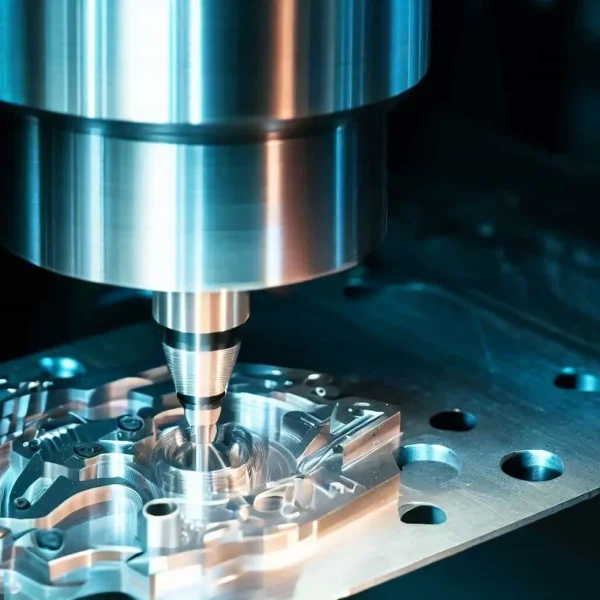
CNC Machining:
- Milling of 7075 aluminum blocks or specific alloys
- Surface finishing according to aesthetic specifications
- Texturing by chemical etching, sandblasting, or polishing
- Machining of inserts and moving elements
Assembly and adjustment:
- Assembly of mold components
- Installation of ejection systems
- Adjustment of closure tolerances
- Preparation of injection system
Phase 3: T0 Testing and Validation (Week 4)
First injection:
- Injection of test parts with the selected formulation
- Evaluation of complete filling and absence of defects
- Dimensional verification in critical areas
- Surface finish analysis
Adjustments if necessary:
- Modification of venting channels
- Adjustment of temperature and times
- Polishing of mark areas
- Optimization of process parameters
Phase 4: Series Production (From Week 4–5)
Manufacturing:
- Injection of the committed units
- Periodic dimensional control
- Controlled demolding and curing
- Cleaning and removal of sprues
Post-processing:
- Sanding and polishing of injection points
- Application of finishes (painting, screen printing, metallization)
- Insertion of additional components if necessary
- Final inspection and documentation
Packaging and delivery:
- Individual protection for transport
- Technical documentation and material certificates
- Direct delivery or coordinated logistics
Process Comparison Table
|
Aspect |
RIM |
Thermoplastic Injection |
Vacuum Casting |
Manual Lamination |
|---|---|---|---|---|
|
Maximum part size |
Up to 2,000 mm |
Up to 800 mm typical |
Up to 600 mm |
No practical limit |
|
Optimal volume |
20–500 units |
>>1,000 units |
10–50 units |
1–10 units |
|
Mold cost |
Medium (€5–15k) |
High (€40–150k) |
Low (€1–3k) |
No rigid mold |
|
Mold lead time |
3–4 weeks |
10–16 weeks |
1-2 weeks |
N/A |
|
Mechanical properties |
Excellent |
Excellent |
Good |
Variable |
|
Dimensional repeatability |
High (±0.3–0.5 mm) |
Very high (±0.1–0.2 mm) |
Medium (±0.5 mm) |
Low (±1–2 mm) |
|
Surface finish |
Excelent |
Excelent |
Very good |
Requires manual work |
|
Modification flexibility |
High |
Low |
Medium |
Very high |
When to Choose RIM
✅ Parts 300–2,000 mm that do not fit in standard injection presses
✅ Series of 20–500 units where a steel mold is not cost-effective
✅ Projects with tight deadlines (need parts in<6 weeks)
✅ Functional validations requiring real mechanical properties
✅ Certification phases with possible design changes
✅ Commercial presentations requiring parts with final appearance
When NOT the Best Option:
❌ Volumes over 1,000 units (consider direct injection)
❌ Extreme tolerances <±0.2 mm across the entire part (consider machining)
❌ Very small geometries <50 mm (vacuum casting is more efficient)
❌Need for specific thermoplastics not available in PU (injection required)
RIM parts accept virtually any surface finish:
Molded-in finishes:
- Technical textures (VDI 18–45, SPI A1–D3)
- Mirror polish for transparent or metallizable areas
- Logo, text, and reference engravings via laser in the mold
- Decorative inserts (film, fabric) applied before injection
Post-mold treatments
- Painting: two-component polyurethane, automotive paint, soft-touch paint
- Screen printing / pad printing: logos, icons, and multicolor texts
- Metallization: chrome, vaporized aluminum for premium finishes
- UV coating: durable protection and gloss
- Functional coatings: anti-slip, conductive (EMI), antimicrobial
Component Integration:
- Threaded metal inserts placed in the mold
- Embedded structural reinforcements
- Over-injected electronic elements
- Seals and gaskets placed during injection
What differentiates RIM from traditional injection?
RIM uses liquid thermoset materials that chemically react in the mold, while traditional injection uses molten solid thermoplastics. RIM operates at 10–20 times lower pressures, allowing cheaper molds and larger parts with reduced investments.
Are RIM parts as strong as injection-molded parts?
In many respects, yes, and even superior in some. RIM polyurethanes excel in impact resistance, energy absorption, and abrasion resistance. Continuous thermal resistance is slightly lower (typically 100–120°C vs. 150–180°C for some technical thermoplastics).
How many parts can I get from a RIM mold?
Aluminum molds: 200–1,000 parts depending on complexity and care
Reinforced epoxy resin molds: 50–200 parts
For larger series, we can produce multiple molds or transition to steel molds for a hybrid process.
What lead time should I consider?
From design approval:
- Epoxy resin mold: 1–2 weeks → first parts in 2–3 weeks
- Aluminum mold: 3–4 weeks → first parts in 4–5 weeks
- Production: 2–4 large parts per day per mold
Can parts be transparent or translucent?
Yes, with limitations. We can achieve yellowish translucent polyurethanes, useful to verify internal flows or lighting. For full optical transparency, other processes like vacuum casting with special resins are more suitable.
Is it possible to make mold changes after the first parts?
Yes, this is one of the main advantages. Aluminum molds can be modified by:
- Adding material (TIG welding + re-machining)
- Removing material (additional milling)
- Changing inserts
- Modifying textures
Changes have additional cost and lead time, but are far more feasible than in hardened steel molds.
Which industries use RIM the most?
Historically automotive, but currently: medical devices, industrial machinery, renewable energy equipment, premium appliances, technical furniture, and any sector needing large parts in limited series with production-quality finishes.
Is RIM compatible with certification requirements?
- Yes. Polyurethane formulations can meet:
- Automotive standards (impact resistance, flammability)
- Railway requirements (EN45545 for flame retardancy and emissions)
- Biocompatibility for medical devices (ISO 10993)
- Electrical certifications (UL94 for flame-retardant materials)
Does your project need large-format parts without waiting months or investing heavily in tooling?
he ProtoSpain RIM process allows you to:
- Have functional parts in 4–5 weeks from design approval
- Validate designs with real mechanical properties before larger investments
- Produce series of 20–500 units cost-effective
- Carry out commercial presentations with production-quality parts
- Meet approval schedules without relying on long steel mold lead times
Simple 3-step process:
- Send us your 3D model (STEP, IGES, CATIA) via our form
- Receive detailed quotation within 48–72h with timeline, cost, and technical recommendations
- Approve and receive your parts in 4–5 weeks, ready to use
Do you have technical questions about whether RIM is the right solution for your project?
Our engineers are available for technical consultations at no obligation. We analyze your specific case and recommend the optimal technology, even if it is not RIM.
- Success Cases
Case 1: Electric vehicle manufacturer – Bumper validation
Challenge:
Customer needed 15 complete bumpers for homologation tests (crash tests, aging) within 6 weeks
RIM Solution:
- Aluminum mold manufactured in 3 weeks
- Production of 15 units in 2 additional weeks
- Material: rigid PU with high impact absorption
- Finish: automotive two-layer paint matching vehicle color
Results:
- Delivery in 5 weeks (vs. 16 weeks with steel mold)
- Tooling cost savings: €45,000
- Homologation completed on time
- Mold reused later for 50 additional pre-sale units
Case 2: Machinery manufacturer – Industrial equipment covers
Challenge:
Series of 80 protective covers 1,200 × 800 mm for specialized machinery. Final design but volume does not justify production mold.
RIM Solution:
- 2 aluminum molds to accelerate production
- Material: rigid structural foamed PU (40% weight reduction)
- Integrated metal inserts for fastenings
Results:
- Complete production in 6 weeks
- Cost per part 60% lower than alternatives
- Molds stored for future series expansion
Conclusion
The RIM process represents the optimal technical and economic solution for the space between handcrafted prototyping and mass industrial production. At ProtoSpain, we combine over XX years of experience in advanced manufacturing technologies with the flexibility and agility needed to turn your developments into high-quality physical parts in record time.
From 100-gram components to 20-kg panels. From unique prototypes to series of 500 units. With RIM, large-scale parts are possible without huge investments.