SLA, SLS and DSLM for Short Runs and Technical Validation
Beyond the prototype: functional, aesthetic, and certifiable parts with the latest technological trends.
Introduction: The New Era of Agile Manufacturing
At ProtoSpain we understand that your goal is not just to “print a part,” but to validate a design, certify a component, or launch a pre‑series to market ahead of your competition.Stereolithography (SLA), Selective Laser Sintering (SLS) and Direct Laser Metal Fusion (DSLM) technologies have stopped being purely experimental tools and have become true production drivers.
Aligned with the latest innovations presented at Formnext 2025, we have optimised our machine park to offer you short runs with final quality, reducing the gap between single prototype and mass injection.Whether for a high‑impact commercial presentation or a wind‑tunnel stress test, we have the precise technology.
Our Technologies and Applications
1. SLA (Stereolithography): Impeccable Aesthetics and Micrometric Precision
The Physical Principle:
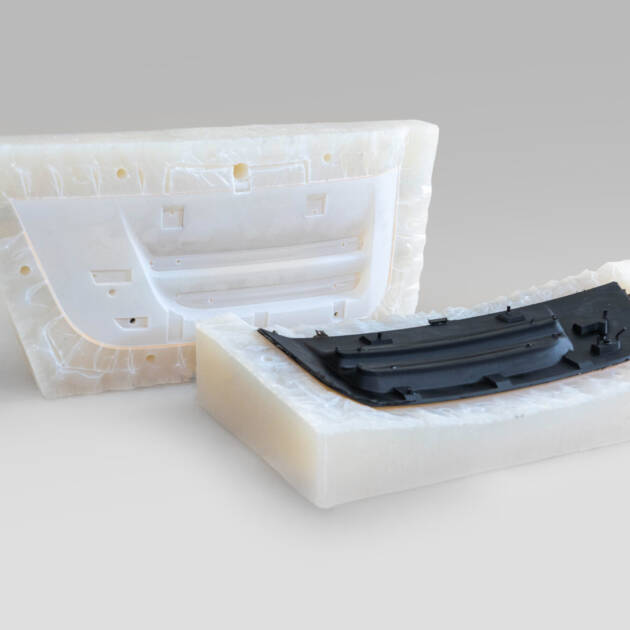
SLA is the mother of 3D printing but has evolved radically. It works through vat photopolymerisation, watt by watt. A high‑precision ultraviolet (UV) laser scans the surface of a tank filled with photosensitive liquid resin. Wherever the laser hits, the liquid instantly solidifies (cures).The platform descends by a fraction of a millimetre (layers from 0.025 to 0.1 mm) and the process repeats.
Industrial Evolution:
We are no longer limited to fragile parts. Thanks to new engineering resins (such as those presented by 3D Systems and Henkel), we now process materials with reinforced polymer chains that withstand UV ageing and moderate mechanical loads.
The Post‑Curing Process: At ProtoSpain, the part that comes out of the machine is only 80 % of the job. We apply a wash cycle in isopropanol and a UV cure in controlled ovens to fully cross‑link the polymer, achieving its maximum thermal and mechanical strength.
Why choose SLA:
- Isotropy: Unlike other technologies, SLA parts are dense and homogeneous; they respond the same to forces in the X, Y, and Z axes.
- Watertightness: Being a solid piece without porosity, it is ideal for validating fluid flow or watertight enclosures (IP67/IP68).
- Extreme Detail: Capable of reproducing mould textures (VDI) or micro‑channels impossible for machining.
- Ideal for: Master models, commercial presentations, fit validation, and translucent parts.
SLA remains the queen of detail. We use next‑generation resins that simulate final thermoplastics (such as ABS or polypropylene) with smooth surface finishes, ready for painting or metallisation.
2026 Trend: We are introducing new high‑performance resins (similar to Accura Xtreme Black seen this year) that offer not only aesthetics but functional durability for electronic housings and visible components.
Use case: Housings for medical devices and wearables where touch and visual appearance are critical for investor approval.
2. SLS (Selective Laser Sintering): Functionality without Geometry Limits
The Physical Principle:
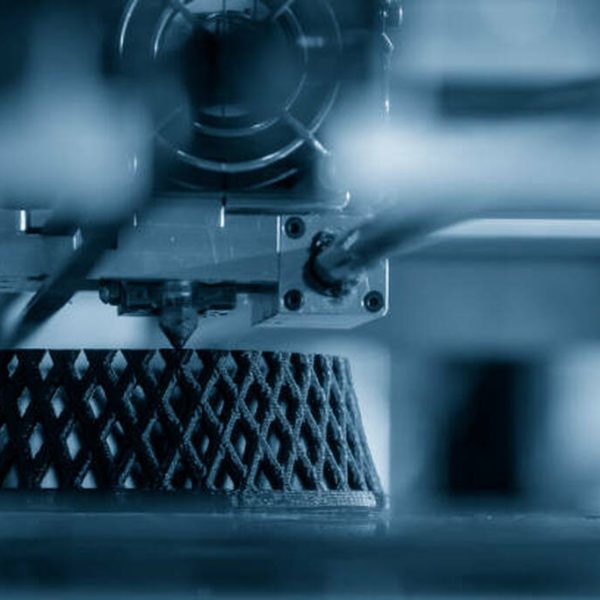
SLS is pure thermal efficiency. We use a high-power laser (usually CO₂) to fuse microscopic particles of polymer powder (nylon/polyamide). The key here is that we do not melt the entire block, but rather “sinter” (fuse by heat and molecular pressure) only the cross-section of the part.
What is revolutionary about SLS is that the unsintered powder acts as a natural support. This allows us to print geometries with impossible overhangs, articulated mechanisms already assembled and, most importantly, to stack hundreds of parts in a single production “cube” (3D Nesting).
Industrial Evolution:
- Hybrid Materials: We are introducing PA11 powders reinforced with carbon fiber or glass beads, ideal for parts that require structural rigidity under a car hood or in a drone.
- Real Sustainability: New powder management systems allow us to reuse up to 70–80% of the unsintered material, drastically reducing cost per part in short runs and minimizing carbon footprint.
Why choose SLS:
- Total Geometric Freedom: Design without thinking about support angles. Make intricate air ducts or housings with internal clips.
- Mechanical Strength: PA12 Nylon parts are tough, resist impacts and chemicals (oils, greases), being perfect for final machinery series or retrofits.
- Ideal for: Short runs (10–500 units), functional parts, clips and mechanisms without supports.
3. DSLM (Direct Shell Laser Melting / Metal 3D Printing): Real Metal, Impossible Geometry
The Physical Principle:
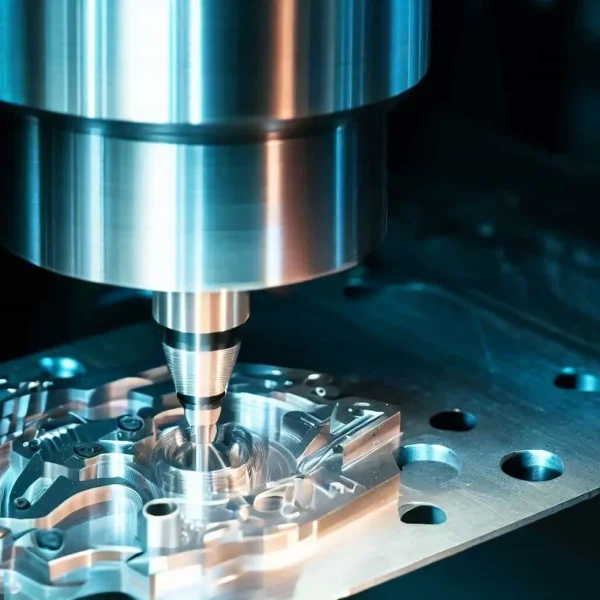
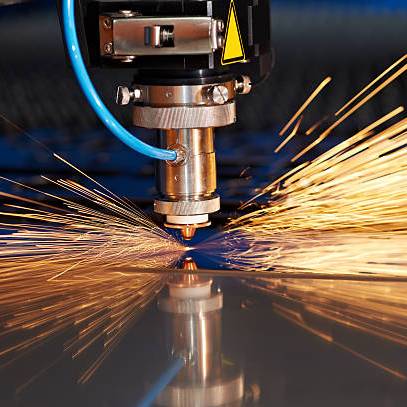
Here we enter the realm of advanced metallurgy. The process is similar to SLS, but on steroids: we use high-power fiber lasers (400W – 1000W) inside an inert chamber (filled with argon or nitrogen) to prevent oxidation. The laser fully melts the atomized metal powder (perfect spherical particles), creating a solid metal part layer by layer.
Once finished, the part is “welded” to the build plate and requires a cutting process (by wire EDM or band saw) and machining of the interfaces.
Industrial Evolution
- Multi-Laser: The 2025 trend is Quad-Laser machines. By using 4 lasers simultaneously, we cut manufacturing times in half, making the production of series of 50–200 metal parts economically viable.
- “Support-Free” Parameters: New scanning algorithms allow us to drastically reduce the supports required to dissipate heat, which means less material waste and fewer hours of manual finishing.
Why choose DSLM:
- Superior Properties: Often, DSLM parts have better mechanical properties than traditional casting due to the rapid cooling that creates a very fine crystalline microstructure.
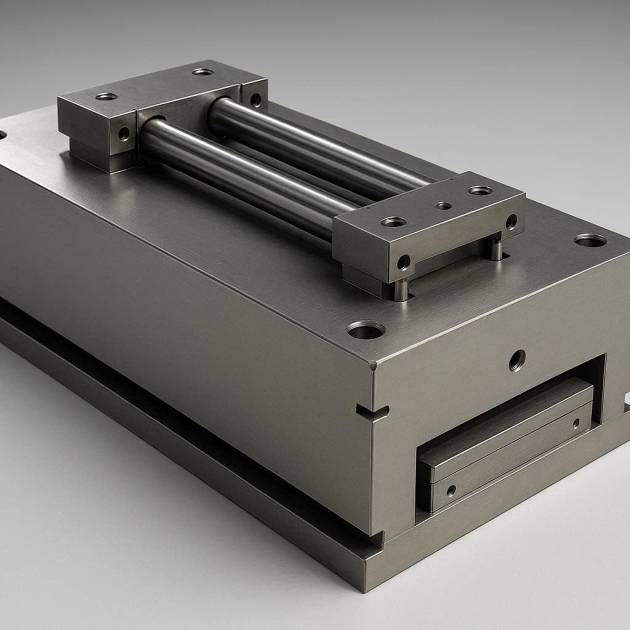
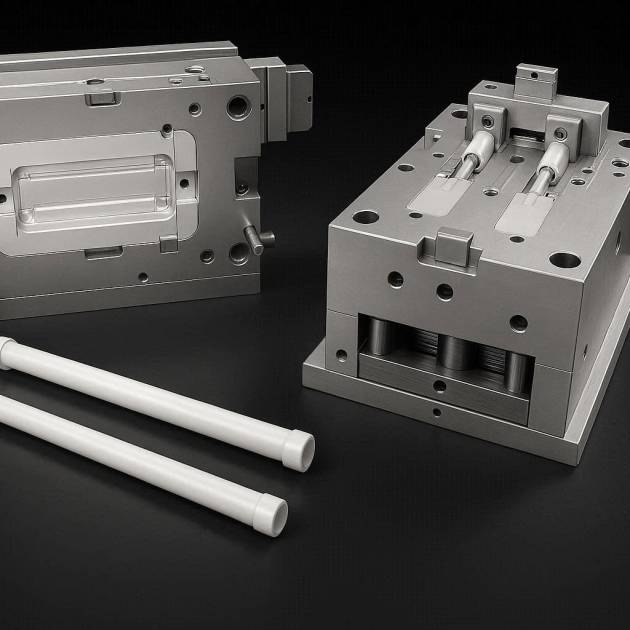
- Cooling Channels (Conformal Cooling): The flagship application. We can manufacture injection molds with curved water channels that follow the shape of the part, reducing injection cycles by 40%.
- Critical Materials: We work with Inconel 718 (for turbines and exhausts), Titanium Ti64 (medical implants and aerospace) and tool steels (Maraging 1.2709) for durable tooling.
- Ideal for: Aerospace, medical implants, internal cooling channels (Conformal Cooling).
- Forget traditional casting for your complex series. With our DSLM technology we print directly in Aluminum (AlSi10Mg), Stainless Steel (316L), Titanium (Ti64) and Inconel.
- Flagship Application: Hydraulic manifolds and heat-exchange components that integrate multiple parts into a single one, reducing weight and failure points.
Quick Comparison Table: Which technology do I need?
Technology | Mechanism | Typical Tolerance | Surface Finish (Ra) | Flagship Materials |
|---|---|---|---|---|
SLA | UV Laser Photopolymerization | ±0.05 – ±0.1 mm | 0.5 – 1.0 µm (Very smooth) | ABS-like resins, PP, Polycarbonate (Transparent), Ceramics. |
SLS | CO₂ Laser Sintering | ±0.15 – ±0.2 mm | 6.0 – 10.0 µm (Rough/Porous) | PA12 (Nylon), PA11, TPU (Flexible), PA + Carbon Fiber. |
DSLM | Fiber Laser Fusion (PBF) | ±0.1 – ±0.2 mm | 3.2 – 6.3 µm (Metallic matte) | Aluminum, Stainless Steel 316L, Titanium, Inconel, Copper. |
Sector-Focused Approach: Solutions that Speak Your Language
- Automotive: Manufacturing of assembly fixtures and validation components for interiors (SLA) and functional under-hood air ducts (SLS) that withstand real operating temperatures.
- Medical & Healthcare: From biocompatible surgical guides to pilot series of devices. The ability for mass customization (seen in Formnext winners such as Grabbit or 3DMyMask) is now accessible for your project.
- Industrial & Machinery: On-demand metal spare parts (DSLM) to avoid line stoppages, eliminating the need to store physical stock.
Ready to validate your next innovation?
Don’t let the cost of a mold slow down your launch.
Consult with our technical team to choose the additive technology that best fits your development phase.