Skip to content Skip to footer
PROTOSPAIN

What is CNC machining?

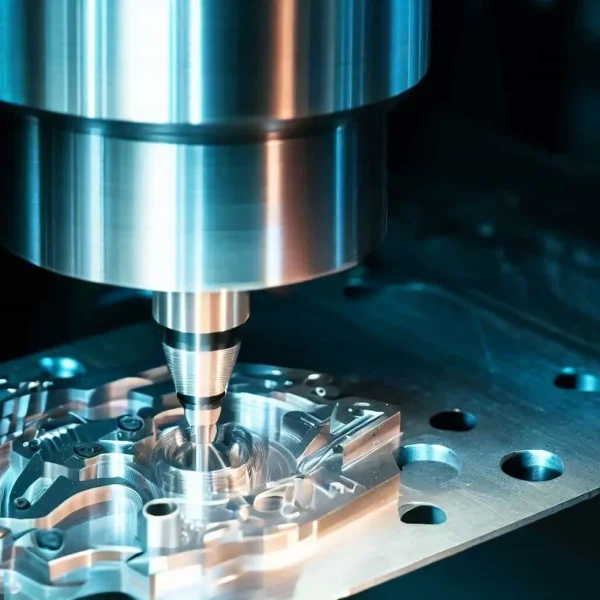
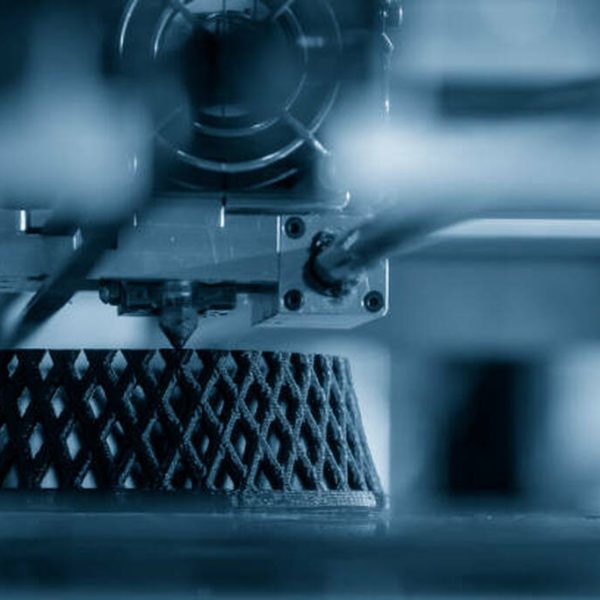
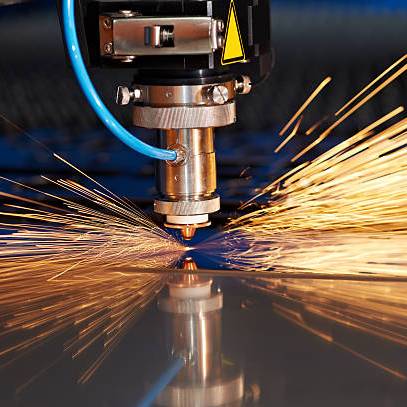
CNC machining (Computer Numerical Control) is the art of shaping precision from solid blocks. A computer-controlled rotating tool progressively removes material until the part required by your design is revealed. Unlike additive processes such as 3D printing, this method starts from a solid bar or block and removes excess material layer by layer, achieving accuracy down to thousandths of a millimetre.

Unlike older methods where operators manually controlled each axis, CNC machining is fully automated. A computer program—generated from your CAD file—controls every movement, every cutting speed, and every tool change. This guarantees repeatability: part number 50 is identical to part number 1.

Why does this matter in prototyping? Because it gives you real materials from the very beginning. Aluminium with the correct weight. Steel with the strength it is meant to have. No simulations, no temporary plastics that will behave differently in production. From the very first prototype, you validate your design with real-world data.

Types of CNC Machining We Offer

At ProtoSpain, we operate multiple CNC technologies, each specialised in addressing different geometries and applications:

  • 3-Axis CNC Milling. The classic configuration: the tool moves along three axes (X, Y, Z) while the part remains fixed on the table. Ideal for prismatic parts, straight slots, precision drilling, and 2.5D geometries. Fast, cost-effective, and more than sufficient for the majority of functional prototypes. Our 3-axis milling machines achieve tolerances of 0.05 mm with ease.
  • Simultaneous 5-Axis CNC Milling. This is where sophistication comes into play. In addition to the three conventional axes, the cutting head rotates along two additional axes, allowing access to the part from virtually any angle in a single operation. The result: sculpted geometries, complex surfaces, and compound angles that are impossible to achieve with conventional 3-axis milling.
  • The main advantage of 5-axis machining is that it minimises part reorientation operations. Fewer handling steps mean a lower risk of losing reference points and higher final accuracy. For complex parts, 5-axis machining is almost always the right choice, although it does require more sophisticated programming.
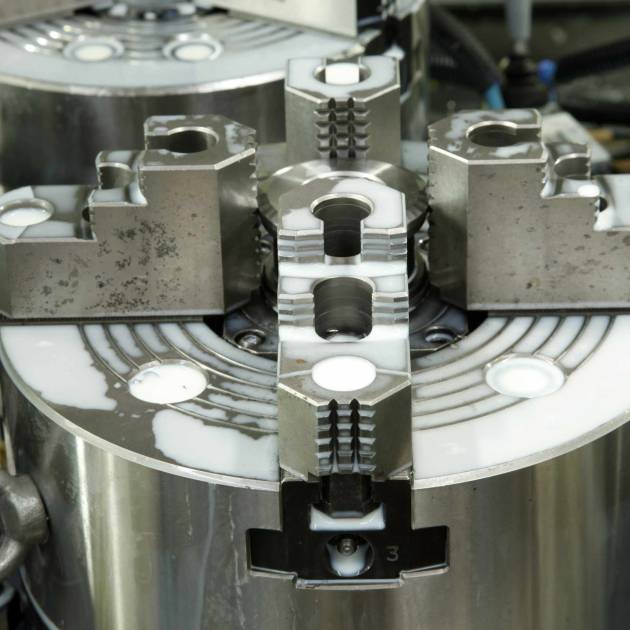
  • CNC Turning. When your part is cylindrical—such as a shaft, pulley, bushing, or mandrel—CNC turning is the definitive solution. The part rotates while the cutting tool advances in a controlled manner, generating circular profiles with perfect concentricity. CNC lathes offer higher cutting speeds than milling, significantly reducing machining times.
  • Wire EDM (Electrical Discharge Machining). This process uses an electrically charged copper or brass wire to “cut” the material through controlled electrical discharges. It may sound like science fiction, but it is exactly what you need when dealing with internal features, sharp corners that milling tools cannot reach, or geometries so complex that conventional machining is no longer viable. Wire EDM achieves accuracies of up to 0.01 mm in otherwise inaccessible areas.
  • Each technology has its own domain. The real skill lies in choosing the right one—or the right combination—for your specific project. That is exactly what our programming department does: it analyses your CAD file and determines the optimal machining strategy.

The Machines That Make It Possible

Our facility is equipped with state-of-the-art CNC machining centres. These machines combine extreme rigidity—because even minimal vibration destroys precision—with submicron-level numerical control accuracy.

The 5-axis milling machines we operate can handle parts up to 1,000 × 600 × 400 mm in a single setup, allowing us to tackle not only small prototypes but also medium-sized components. Our CNC lathes support parts up to 300 mm in diameter and 500 mm in length.
If larger dimensions are required, we work with a trusted partner network. For pure prototyping, these ranges cover 95% of typical projects.

Each machine is equipped with automatic tool changers, intelligent cooling systems that adapt flow rates according to material and cutting speed, and high-precision probes that verify dimensions during machining. If a deviation is detected, the system alerts the operator before the part becomes scrap.

Materials: From the Common to the Exotic

We work with virtually any machinable material. The most commonly used materials for prototyping include:

Metals:

  • Aluminium (6061, 6082, 7075-T6 series): Lightweight, easy to machine, and ideal for aerospace, automotive, and electronics components. The 7075 series provides higher strength for critical applications.
  • Stainless steel (304, 316, 316L): Essential for medical devices, food-processing environments, or any application where corrosion is the enemy. The 316L grade is biocompatible.
  • Hardened and tempered carbon steels: Chosen when extreme hardness, high mechanical strength, or load-bearing capacity is required. Commonly used for tooling, dies, and machinery components.
  • Others: Titanium Grade 5 (for aerospace and medical implants), brass and copper (electrical and thermal prototypes), magnesium (when every gram matters).

Engineering Plastics:

  • POM (Delrin): Gears, mechanisms, and parts that require smooth sliding without lubrication.
  • PA6 / PA12 (Nylon): Resistente, tenaz, ampliamente usado en componentes funcionales.
  • PC (Polycarbonate): Transparency combined with high impact resistance; ideal for optical prototypes or structural windows.
  • ABS and PP: Consumer-grade plastics; machined when you need to validate fits or interfaces before injection moulding.
  • PEEK: The Ferrari of engineering plastics. Withstands extreme temperatures (up to 250 °C continuous), chemically aggressive environments, and radiation. Expensive, but when required, it is often the only material that works.
  • PTFE (Teflon): Extremely low friction and outstanding chemical resistance. Commonly used in valves, seals, and laboratory components.

Need a material not listed? Just ask. We have machined everything from optical glass to ceramic materials. If it exists and can be machined, we will evaluate it.

Tolerances and Surface Finishes

When we talk about CNC precision, concrete numbers matter. Our standard tolerances are 0.05 mm on critical dimensions. To put that into perspective, that’s 50 microns—about the thickness of a human hair.

Need more? We can achieve tolerances down to 0.02 mm (20 microns) through optimised finishing machining and subsequent verification using a coordinate measuring machine (CMM). This already falls within the realm of watchmaking-level precision.

Beyond dimensional accuracy, surface quality also matters. CNC machining typically produces a surface roughness of Ra 1.6 microns (Ra 1.6 µm). If a finer finish is required—such as a mirror-like surface suitable for optical applications, or a smooth finish for medical devices—we can progressively polish parts down to Ra 0.1 µm.

Surface Finishes: Turnkey Parts

This is where we make the difference. We don’t deliver half-finished parts that you then have to send to another supplier for painting, anodising, or engraving. At ProtoSpain, parts leave our facility fully finished—ready for final use or to be presented directly to your client.

Our range of surface finishes covers virtually any requirement:

  • Protective and functional treatments: aluminium anodising (natural or coloured), electroplating (nickel, gold, silver), chrome plating, and galvanising. These treatments improve corrosion resistance, increase surface hardness, and extend the service life of components.
  • Aesthetic finishes: painting in any Pantone or RAL colour, mirror polishing, directional brushing, matte bead blasting, and transparent or translucent surfaces. Everything required to ensure your prototype looks exactly like the final product.
  • Marking and customisation: pad printing, screen printing, and laser engraving for logos, technical references, or traceability codes.

The process is simple: you send us your 3D design specifying the material, critical tolerances, and the desired surface treatment. Our programming department prepares the machining process, we manufacture the part, apply the finishes, and verify dimensions using CMM before shipping. You receive a part that is ready to perform.


​​

Short production runs are our specialty. We manufacture everything from single parts to batches of up to 200 units for pre-series production, market validation, or technical testing. This production range is ideal for startups piloting their products, R&D departments validating concepts, or manufacturers requiring functional samples before committing to larger tooling investments.

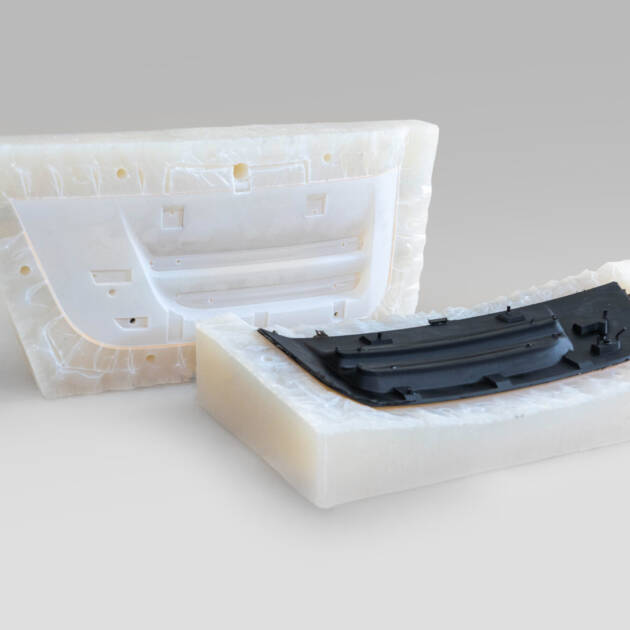
Why CNC machining for short runs? Because you avoid programming costs that are only paid once, you don’t need to invest in moulds, and you obtain parts made from the final production material from the very first unit. The unit cost progressively decreases as volume increases, but even for a single part it often makes economic sense—especially when the alternative involves waiting weeks for an injection mould.

A functional prototype is not a pretty model for meetings. It is a part that must behave exactly as it will in production: withstand loads, fit with other components, resist operating temperatures, and endure fatigue cycles. CNC machining delivers exactly that, because we work with real, production-grade materials.

Aerospace-grade 7075-T6 aluminium for lightweight, high-strength components. 316L stainless steel when corrosion resistance and biocompatibility are required. PEEK for chemically aggressive or high-temperature environments. POM–Delrin for precision gears and mechanisms.
No simulations, no approximations: your functional prototype has the same mechanical properties as the final production part.

Development engineers use these parts for real assembly tests, load testing, thermal analysis, and tolerance verification. When an issue is identified at this stage, the cost of correcting it is only a fraction of what it would be if discovered after the production mould has already been manufactured.

Let’s be clear: there’s no point in claiming high precision if lead times then spiral out of control. Our production facility is sized to respond with agility. 3- and 5-axis machining centres, CNC lathes, and wire EDM for details that milling tools simply cannot reach.

A batch of simple aluminium parts can be in your hands within 3–5 working days. More complex projects or short runs of 50–100 parts typically require 1–2 weeks. Compared to the 4–8 weeks needed to manufacture an injection mould, the difference is decisive for anyone in a hurry to validate and move forward.

And yes—when deadlines truly tighten, we go the extra mile. We have delivered urgent parts within 24 hours for critical proof-of-concept testing. It’s not the standard scenario, but it’s part of our capabilities when the situation demands it.

We are not the cheapest option on the market. We are the option that delivers on time, with the promised quality, and saves you the headache of coordinating three different suppliers to get a finished part.

Our technical team reviews every project before machining begins. If we see that your design can be optimised for CNC machining, we will tell you. If a tolerance doesn’t make sense for the application, we’ll discuss it with you. We don’t just execute—we advise, because our success depends on your project working right the first time.

We work with the automotive, aerospace, medical device, consumer electronics, and industrial machinery sectors. Each industry has its own specific requirements—and we understand them. A wind tunnel bracket is not the same as a surgical instrument, even though both demand tight tolerances.

CNC machining is no longer limited to large production runs. Today it represents the core of functional prototyping when you need to validate parts under real conditions: tight tolerances, final materials, surface finishes that make the difference between a laboratory prototype and something you can assemble, test and break if necessary. At ProtoSpain we work with 3 and 5 axis milling centers, CNC lathes with driven tools and electro-erosion, transforming blocks of aeronautical aluminum, stainless steels or technical plastics into components ready for assembly in medical devices, crash validations in automobiles or fatigue tests in aerospace.

What makes CNC machining the reference process is not only the millimetre-level precision we routinely achieve—±0.05 mm on critical dimensions—but also its material and functional versatility. From electropolished 316L stainless steel surgical instrument prototypes to lightweight magnesium drone housings, and functional POM–Delrin gears capable of withstanding thousands of test cycles.
This is tangible engineering: parts that breathe, fit, resist, and fail exactly where they are supposed to—so you can iterate your design before committing to production tooling.

The sector is undergoing a profound transformation. The integration of artificial intelligence and machine learning into CNC controllers now enables real-time adjustments of cutting speeds, depth of cut, and tool life management—reducing downtime by up to 30% and improving surface finishes on difficult-to-machine materials such as Inconel or titanium.
Predictive systems analyse vibration, temperature, and cutting forces to anticipate failures and automatically optimise machining parameters—something that would have been unthinkable just five years ago.

Automation with collaborative robots (cobots) is democratising capabilities that were once reserved for large machining shops. Cobots can load and unload parts, replace worn tools, and perform in-situ dimensional inspections using machine vision—enabling 24/7 production of validation batches ranging from 50 to 200 parts without constant human intervention.
This dramatically shortens lead times during critical development phases, where every single day matters.

Simultaneous multi-axis machining is no longer a luxury—it has become a competitive necessity. 5-axis machining centres enable geometries that were previously impossible or required multiple setups, reducing positioning errors by up to 62%, according to aerospace industry data.
For complex prototypes—turbine components, drone structures, or customised implants—this translates into higher accuracy and lead times reduced by half.

Hybrid CNC + additive manufacturing is emerging as a solution for parts that combine internal geometric freedom—such as metal 3D-printed conformal cooling channels or lattice structures—with high-precision surface finishes achieved through CNC machining of functional areas, reaching Ra 0.4 μm.

This is where CNC machining shines without competition. Functional validation requires parts made from final-production materials with certified mechanical properties. A prototype of an aerospace structural component machined from 7075-T6 aluminium replicates exactly the fatigue behaviour, yield strength, and toughness of the production part—something no polymer-based additive technology can offer.

In medical devices, material traceability and dimensional tolerances are non-negotiable requirements. A prototype of surgical instrumentation machined from 316L stainless steel meets ISO 13485 specifications from the very first test cycle, enabling pre-clinical validation without rework.
Critical surface finishes required for biocompatibility—<0.8 μm—are achieved directly through finishing machining, without the need for complex secondary processes.

In automotive applications, machined prototypes of engine, transmission, and chassis components enable crash tests, vibration testing, and thermal validation with data that can be directly extrapolated to production. The IT7–IT8 tolerances we guarantee on shafts and bearings ensure proper fit and real-world performance on test benches, bringing design issues to light early—issues that would otherwise take weeks and thousands of euros to correct once an injection mould is already in place.

CNC machining is unbeatable for validation runs of 10 to 200 partsthat grey area where injection moulds are not yet cost-effective and 3D printing cannot deliver final material properties. We produce component batches for industrial pilots, field testing, and certification processes with series-level quality, delivered within 1–2 weeks.

A typical case: a medical electronics client needs 50 housings in medical-grade PEEK for clinical validation equipment. We machine all 50 units with ±0.1 mm tolerances, install metal threaded inserts, apply laser marking with traceability codes, and deliver within 10 working days.
The cost per part is only a fraction of the injection mould they will eventually manufacture—yet with identical material properties for critical validation.

Surface finishes are not cosmetic in functional prototyping—they are technical specifications. Type II and Type III anodising on aluminium transforms aerospace and automotive prototypes into parts with certified corrosion resistance exceeding 1,000 hours in salt spray testing and surface hardness ranging from 300 to 700 HV, both critical for environmental and durability testing.

Electroless nickel plating on steels and aluminium provides uniform coatings even on complex geometries with internal cavities. This is essential for mould prototypes or hydraulic components, where wear resistance and dimensional uniformity are critical.​

PVD coatings such as TiN, CrN, and DLC applied to tool prototypes or tribological components enable accelerated wear testing with ultra-low coefficients of friction and hardness values exceeding>2,000 HV. This allows designs to be validated before investing in full-scale production treatments.

For aesthetic validation, multi-layer industrial painting—primer + base coat + clear coat—with spectrophotometric colour matching (ΔE<1) transforms machined prototypes into samples indistinguishable from the final product. This enables presentations to investors, trade fairs, or user focus groups with real end users.

The aerospace sector leads the demand for ultra-precision machining. Landing gear components, fuselage structures, and engine parts made from titanium alloys and superalloys require ±0.02 mm tolerances and AS9100 certification—standards that only CNC machining can reliably guarantee.

In medical devices, CNC machining produces everything from custom orthopaedic implant prototypes in Ti-6Al-4V titanium to precision surgical instrumentation in stainless steel, meeting FDA regulations and USP Class VI biocompatibility requirements.

The automotive industry consumes massive volumes of machined prototypes—from engine and transmission components to assembly tooling and dimensional control fixtures. The tight tolerances and Class A surface finishes we achieve enable assembly trials, NVH (noise, vibration, and harshness) validation, and crash testing using parts that are fully representative of the final design.

Los talleres CNC evolucionan hacia fábricas inteligentes: sensores IoT en cada máquina capturan datos de producción en tiempo real consumo de herramienta, tiempos de ciclo, desviaciones dimensionales que alimentan sistemas de análisis predictivo. Los digital twins simulaciones virtuales que replican el comportamiento de la máquina física permiten optimizar programas CAM antes de mecanizar la primera viruta, reduciendo prueba-error y desperdicio material.

Cloud connectivity allows development engineers to remotely monitor the progress of their prototypes, receive quality alerts, and adjust specifications in real time—shortening critical feedback loops in agile product development.

Our value proposition is straightforward: state-of-the-art machining centres combined with engineers who truly understand your project.
We don’t just cut metal—we deliver solutions.
Does your design include a critical area that is difficult to machine? We propose an alternative part orientation or a minor geometry adjustment that saves hours of machine time without compromising functionality.
Do you need 20 identical parts with full traceability? We implement statistical process control and serialised documentation per part.

We work with aerospace-grade 7075-T6 aluminium, stainless steels 304/316/316L, Grade 5 titanium, Inconel 718, engineering plastics such as PEEK, POM, and PA66-GF, as well as copper, brass, and exotic materials upon request.
Standard tolerances are ±0.05 mm, with ±0.02 mm achievable on critical features through optimised finishing machining and CMM verification.
Realistic lead times: batches of 1–5 simple parts in 3–5 days; complex geometries or series of 50–100 units in 7–14 days, including surface treatments. Express service (24–48 hours) is available for development emergencies—when an urgent prototype makes the difference between hitting a milestone or missing a market window.

Every project includes a free DFM analysis before machining. We review tolerances, surface finishes, and part orientation, and suggest optimisations that save time and cost—without endless email threads. Because in the end, what matters is that your prototype works, fits, and validates your concept so you can move forward with confidence.

Upload your CAD file and receive a detailed quote within 24 hours, with committed lead times and transparent technical advice—no fine print. At ProtoSpain, CNC machining isn’t just a service; it’s your competitive advantage in product development.

Cumpliendo compromisos de calidad

ACERCA DE PROTOSPAIN

PROTOSPAIN ofrece servicios de fabricación de prototipos rápidos, pre – series, moldes de prototipado y moldes de fabricación en serie, mediante diferentes tecnologías, cumpliendo sus compromisos de calidad, plazos y costes contenidos.

OFICINAS

Parque Tecnológico de Asturias, Edificio CEEI, 33428 Llanera, Asturias, España

[email protected]
+34 985 980 098

INFORMACIÓN LEGAL

Aviso Legal

Política de Privacidad

Política de Cookies

Política de Gestión

CERTIFICACIÓN ISO 9001
CON LA COLABORACIÓN DE:

© 2026. Todos los derechos reservados.